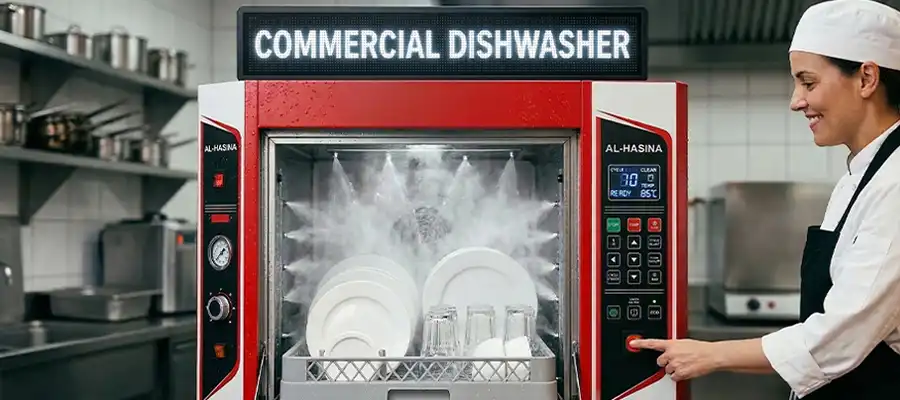
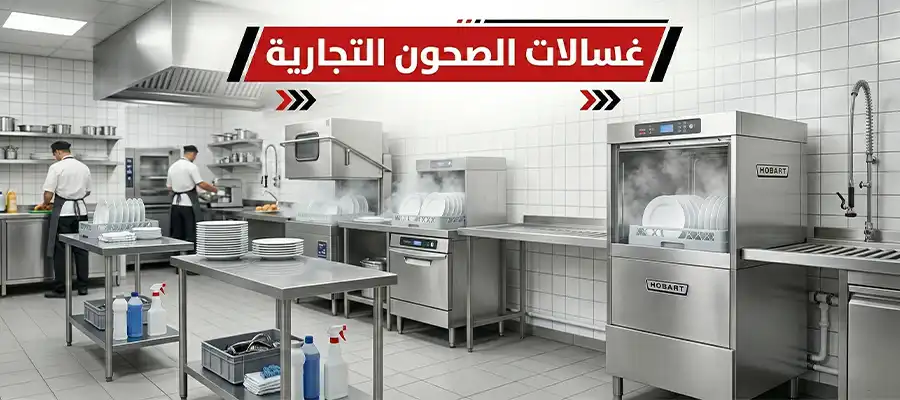
The size of a commercial dishwasher is one of the key factors that determine the efficiency and speed of cleaning operations in professional kitchens. Choosing the right size ensures the ability to handle large quantities of dishes and cookware with high efficiency, while maintaining optimal energy and water consumption and ensuring smooth daily workflow with no delays or congestion in the kitchen.
Dishwasher Sizes for Restaurants and Hotels
Commercial dishwasher sizes vary depending on the workload and the number of meals served. Selecting the right model is essential to maintaining efficiency and reducing delays during peak hours.
1. Undercounter Model
- Suitable for cafés, bars, and small kitchens with low washing volume.
- Requires very little space and is usually installed directly under the worktable, with a capacity of 20–60 racks per hour.
- Drawbacks: Not ideal for large volumes or heavy-duty use; requires manual loading and offers limited workflow.
2. Door-Type / Hood-Type Model
- Used in medium-sized restaurants, where the hood is lifted to load racks, then lowered to run the cycle.
- Offers higher capacity than undercounter units, usually 60–180 racks per hour depending on the model.
- Requires more space than undercounter dishwashers and benefits from a loading/unloading station, making it ideal for normal and mid-sized operations.
3. Conveyor Dishwasher
- Designed for very large operations such as hotels, cafeterias, and banquet halls.
- Dishes are loaded on a conveyor belt that moves through washing, rinsing, and drying stages.
- Provides extremely high output: 150–400 racks per hour or more.
- Requires spacious areas, advanced technical setup, and specialized installation—costly but extremely efficient for continuous high-volume use.
4. Flight-Type Dishwasher
- The highest category in size and capacity, used in very large facilities such as universities, hospitals, and food factories.
- Often operates without standard racks, using built-in holders, and can clean thousands of dishes per hour.
- Drawbacks: High cost, requires full planning for installation and support facilities.
Best Commercial Dishwashers
If you’re looking for top commercial dishwasher options for restaurants or hotels, here are some recommended models:
- Hobart AM15 Commercial Dishwasher: Powerful and ideal for heavy-duty and continuous use.
- Jackson WD-44 Commercial Dishwasher: Compact yet high-capacity, suitable for kitchens with limited space.
- MEIKO DV 80.2 GiO Commercial Dishwasher: Features advanced technologies such as water filtration and steam control.
- CMA Freedom X-140 Commercial Dishwasher: Mid-priced with good performance; ideal for medium operations.
- Hobart LX Series Undercounter Dishwasher: High-capacity undercounter unit for cafés and small restaurants.
- Jackson WD-45 Conveyor Dishwasher: Industrial-grade conveyor system for hotels and high-traffic cafeterias.
- Winterhalter C500 Undercounter Dishwasher: Excellent performance for small spaces.
- CMA-250UC50E Undercounter Dishwasher: Economical undercounter option for daily use.
Specifications of Industrial Dishwashers
In restaurants and hotels, industrial dishwashers are essential for fast and effective cleaning of large quantities of tableware. The following specifications are key to achieving optimal performance:
- Construction Material: Stainless-steel body for durability and easy cleaning.
- Capacity and Cycle Speed: Example: 60 racks/hour or more, with cycle times between 60–120 seconds.
- Water Consumption: Some models use only 2.5–3 liters per rack.
- Washing and Rinsing Temperatures: Final rinse typically ranges from 82–90°C for sanitization.
- Dimensions and Installation Space: Example: devices measuring 700×785×1480 mm.
- Energy & Water Efficiency: Features such as heat recovery systems reduce running costs.
- Ease of Maintenance: Clear control panels, strong pumps, and accessible filtration systems.
Large Dishwashers for Restaurants
Commercial kitchens and hotels handle large quantities of dishes daily, making high-capacity dishwashers essential. These machines improve service speed, reduce costs, and maintain high hygiene standards.
- Conveyor models can process hundreds or thousands of racks per hour.
- The choice depends on facility size—large venues require high-capacity units, while medium restaurants may opt for smaller systems.
- Important specifications include rack count per hour, cycle speed, water and energy consumption, and sanitizing temperature.
- Infrastructure considerations include space, electrical supply, water lines, and drainage requirements.
- A large dishwasher reduces labor time and streamlines the workflow during peak hours.
Small Dishwashers for Hotels
For small restaurants or boutique hotels with limited space, small dishwashers are a practical and efficient solution:
- Undercounter dimensions such as 460×700×600 mm or 600×700×600 mm.
- Capacity of 15–30 racks per hour.
- Low water consumption: around 1.7–2.4 liters per cycle.
- High-temperature final rinse (approx. 82°C) for sanitization.
- Stainless-steel structure for durability in professional environments.
- Electrical compatibility: typically 220–240 V, suitable for small spaces.
Importance of Dishwashers for Restaurants & Hotels
Commercial dishwashers play a critical role in ensuring efficiency and hygiene:
- Handle large quantities quickly, reducing delays during peak hours.
- Meet hygiene and sanitization standards with high-temperature rinsing.
- Reduce water, energy, time, and labor costs versus manual washing.
- Improve customer experience with consistently clean tableware.
- Offer long-term investment value for high-traffic establishments.
Frequently Asked Questions
What is the right dishwasher size for your restaurant?
It depends on daily guest count and workflow. Large restaurants need high-capacity units, while cafés and small venues can use undercounter models.
Do industrial dishwashers consume a lot of electricity?
Consumption depends on size and cycle frequency, but modern models are energy-efficient compared to manual washing.
What is the difference between manual and automatic dishwashers?
Manual ones require more labor and time; automatic dishwashers offer faster and more efficient full cycles.
How much do commercial dishwashers cost?
Costs vary by size and features—from a few thousand to tens of thousands of dollars for large hotel-grade systems.
Conclusion
This guide has covered dishwasher sizes for restaurants and hotels, highlighting the importance of selecting the right unit to ensure efficient workflow, fast service, and high hygiene standards in professional environments.







 Beverage Machines
 Coolers
 Food Preparation
 Heating & Cooking
 KAZ Commercial