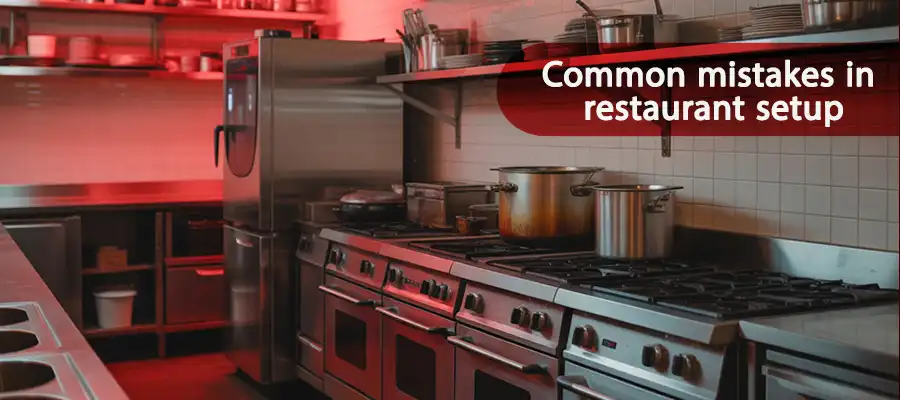
Many restaurant owners make critical mistakes during the setup phase, especially at the beginning, due to excessive enthusiasm, lack of experience, or poor planning. These mistakes can lead to significant budget waste, operational disruptions, and in some cases, complete project failure—even if the business idea itself is strong. Therefore, understanding common mistakes and avoiding them from the start is a fundamental step for anyone aiming to establish a successful restaurant built on solid foundations. In this article, we highlight the most common mistakes made during restaurant setup and explain how to avoid them to ensure a strong and stable launch.
Common Mistakes When Setting Up Restaurants
When preparing a restaurant, many business owners make errors that negatively impact operational efficiency and increase costs without real value. Being aware of these mistakes and avoiding them can help you build a successful restaurant from the very beginning.
1. Poor Planning or Lack of a Clear Feasibility Study
Starting a restaurant without a detailed feasibility study of the market, target customers, and costs can result in unrealistic estimates of expenses and revenues, exposing the project to unexpected financial pressure.
2. Choosing an Inappropriate Location
Location has a major impact on restaurant success. Selecting a place with low foot traffic or one that does not match the target audience can significantly reduce revenue from the start.
3. Unpractical Kitchen Design or Poor Space Distribution
Designing a kitchen without considering workflow (from storage to preparation, cooking, and service) can cause staff interference and slow service. Poor space utilization also reduces team productivity.
4. Choosing Inappropriate or Very Cheap Equipment
Purchasing equipment that does not match the scale of operations or the type of food served can reduce efficiency and lead to frequent maintenance or early replacement. Investing in suitable, high-quality equipment saves time and money in the long run.
5. Neglecting Ventilation and Safety
Proper ventilation and safety systems such as fire extinguishers and smoke detectors are essential in any kitchen. Ignoring them can lead to health risks and legal violations.
6. Poor Storage Organization
Failing to plan sufficient storage space or organizing it inefficiently creates clutter, increases food waste, and may lead to food contamination.
7. Ignoring Proper Staff Training
Even with modern equipment, lack of staff training on equipment use and service standards reduces efficiency and increases operational mistakes.
8. Neglecting Marketing Before and After Opening
Assuming customers will come automatically after opening is a common mistake. Pre-launch marketing and promotional campaigns attract a larger audience from day one.
9. Unclear or Overly Large Menu
A menu with too many items and no clear focus reduces restaurant identity and increases operating costs without adding real customer value.
10. Weak Financial Management
Poor budget control and lack of an emergency financial reserve are common reasons why some restaurants fail despite good customer demand.
Important Tips to Avoid Common Restaurant Setup Mistakes
Setting up a successful restaurant requires more than buying equipment and choosing a location. Following practical, well-planned tips helps avoid common mistakes and puts the restaurant on the right path toward success and profitability.
-
Conduct a detailed feasibility study to accurately estimate costs and revenues.
-
Choose the location carefully, considering customer traffic and accessibility.
-
Design the kitchen layout efficiently to support smooth workflow and productivity.
-
Select high-quality equipment suitable for the restaurant concept.
-
Train staff thoroughly before opening.
-
Follow hygiene and safety standards strictly.
-
Create a focused, well-balanced menu.
-
Invest in marketing before opening to build awareness and excitement.
-
Manage the budget wisely and allocate emergency reserves.
-
Use modern technology such as POS systems and inventory management tools.
The Importance of Marketing a Restaurant Before Opening
Pre-opening marketing is just as important as preparing the space and kitchen. Early promotion attracts potential customers, creates anticipation, and ensures a strong launch.
-
Build brand awareness before opening.
-
Attract potential customers through targeted advertising and social media campaigns.
-
Identify the target audience early.
-
Create excitement and curiosity with previews and behind-the-scenes content.
-
Encourage opening-day attendance through special offers and promotions.
-
Collect early feedback to refine the menu and service.
Professional Criteria for Choosing Restaurant Equipment
Choosing restaurant equipment is one of the most critical steps in setting up a successful food business. Equipment directly affects food quality, service speed, and operational efficiency.
-
Match equipment to the restaurant type and scale.
-
Focus on quality and durability from trusted brands.
-
Ensure high performance and daily capacity suitability.
-
Choose equipment that is easy to operate and maintain.
-
Select energy-efficient appliances to reduce operating costs.
-
Verify safety and compliance with standards.
-
Ensure compatibility with available kitchen space.
-
Use advanced technology and multifunctional equipment.
-
Balance cost versus value to avoid unnecessary expenses.
Best Restaurant Equipment Available at Target Egypt
Target Egypt is one of the leading suppliers of high-quality restaurant and bakery equipment, offering integrated solutions that include cooking equipment, refrigeration, ovens, fryers, refrigerators, and dishwashers. The company focuses on quality, technical support, and after-sales service to meet the needs of both small and large projects.
ACE YH-2WN Electric Food Warmer
An efficient solution for commercial kitchens, buffets, and catering services, designed to keep cooked food at ideal serving temperatures for extended periods.
Key Features:
-
Dual-basin capacity for holding two food types simultaneously
-
Water-bath heating for even heat distribution without drying food
-
Adjustable thermostat for precise temperature control
-
Durable stainless steel construction
-
Indicator lights for operation and heating status
-
Easy cleaning and maintenance
-
Compact countertop design
-
Wide temperature range (30°C–90°C)
-
Efficient power consumption suitable for commercial use
TRUE T-12-HC Single-Door Stainless Steel Refrigerator
A professional refrigeration solution for commercial kitchens, restaurants, and hotels, offering large storage capacity with a compact footprint.
Key Features:
-
12.1 cu. ft. (approx. 343 liters) storage capacity
-
Advanced cooling system (0.5°C–3.3°C) using eco-friendly R290 refrigerant
-
Self-closing door for energy efficiency
-
Excellent thermal insulation
-
Adjustable PVC-coated wire shelves
-
Durable stainless steel and aluminum construction
-
Easy cleaning and maintenance
-
Space-saving design
-
High electrical efficiency and stable performance
Kaz Commercial Dough Mixer – 10 Liter
The Kaz 10-liter commercial dough mixer is ideal for bakeries, pizza shops, and restaurants requiring fast and consistent dough preparation.
Key Features:
-
Fast and efficient mixing
-
Consistent dough texture
-
Durable stainless steel body
-
Suitable bowl capacity for small to medium operations
-
Multiple attachments for different mixing needs
-
Stable, professional design for safe operation
Frequently Asked Questions About Common Restaurant Setup Mistakes
What are the most common mistakes made by new restaurant owners?
Poor planning, choosing the wrong location, purchasing unsuitable equipment, and neglecting staff training.
How can I avoid mistakes when choosing restaurant equipment?
By focusing on quality, suitability for the menu, ease of operation and maintenance, and energy efficiency.
Does kitchen design affect restaurant success?
Yes, poor layout slows operations and increases errors, while good design improves efficiency and service speed.
Conclusion
We have highlighted the most common mistakes made when setting up restaurants—from planning and design to equipment selection, staff training, cost management, and pre-opening marketing. Understanding and avoiding these mistakes helps business owners establish restaurants more efficiently, ensures smooth operations, delivers high-quality service, and provides a positive customer experience from day one.
Read Also:
Best Restaurant Equipment for Sale in Egypt 2026





 Beverage Machines
 Coolers
 Food Preparation
 Heating & Cooking
 KAZ Commercial